Mary Blessing
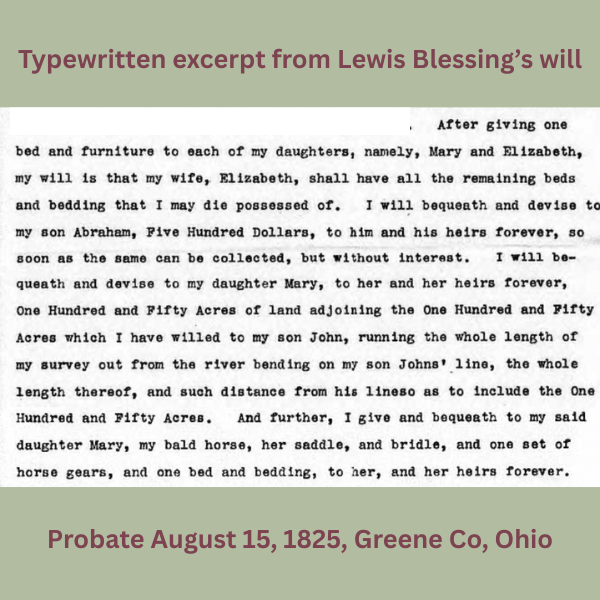
When Mary’s father, Lewis Blessing, died in 1825, he left her 150 acres of land next to the 150 acres that he had bequeathed to her brother, John, “running the whole length of my survey out from the river bending on my son John’s line, the whole length thereof, and such distance from his line so as to include the 150 acres.”
He also left her “my bald horse, her saddle, and bridle, and one set of horse gears, and one bed and bedding.”
Twenty-eight years old and unmarried, she lived with her mother, Elizabeth, her brother, John, and her sister Elizabeth in the brick house their father had built overlooking the Little Miami river.
Over the years, Mary Blessing’s mother may have talked to her about needing to find a husband who would take care of her. But Mary probably didn’t see the need. She owned land, crops, and livestock. Here father’s will had specified that she and her sister would keep their inheritance so long as they didn’t marry, so perhaps she wasn’t willing to give up everything to satisfy societal customs.
While she may relished her autonomy in an era where few women had that luxury, it’s not unthinkable that she also wished to have a family.
When the Blessings had come out to Ohio in 1824, twenty-three-year-old Thornton Lucas accompanied them to assist in setting up the homestead and managing the livestock and crops. He lived on the property in the bunkhouse for hired hands.
Having known each other for a long time and living on the same land, it’s not surprising that Mary and Thornton fell in love, or at the very least, developed an affection for each other. Or maybe they were in love all along but Mary couldn’t see giving up her land and independence even for love.
The Generational Torch Passes
Whatever the reason, Mary Blessing and Thornton Lucas were married on November 27, 1838, in Xenia, Ohio. She was forty-one years old, and he was thirty-eight. When they married, the 150 acres that Lewis left to his daughter became Thornton’s property, as was customary of the times.
Mary had been living in the smaller house that John had built for his mother and sisters, per their father’s wishes in his will thirteen years before. After her wedding, she and Thornton moved into the main brick family home that John also occupied.
The Lucas’s had three children—a baby born in 1839 who died in infancy, John Basset Lucas, born on July 2, 1842, and Lewis Morton Lucas, born on September 19, 1843.
On September 17, 1848, the family matriarch, Elizabeth Bartsherrer Blessing, passed away at age seventy-six and was buried in the family plot at Woodland Cemetery in Xenia, Ohio.
When her husband, Lewis had passed away in 1825, his will stipulated that she receive twenty acres of land on their property in her own name, as well as “the privilege of taking fire-wood and timber to make any repairs that she may stand in need of, off the track of land that I now own. My further will and desire is, that all the money that my said Wife, Elizabeth, has in possession, and all notes that she holds for cash, loaned in Virginia, is to be for her own use and benefit, to her and her heirs forever.”
Lewis had also left Elizabeth his wagon, jackscrew, and gears and two horses—his old brown horse and young black mare—and all his cattle and sheep, all the kitchen and cupboard furniture, and all his wheat, rye, corn, and oats that he owned.
Additionally, Elizabeth inherited one loom and apparatus, one spinning wheel, one chest, one ax, and all the linen on the premises, along with all beds and bedding, excluding the bed and furniture given to his daughters, Mary and Elizabeth.
Upon their mother’s death, these possessions now passed to Lewis and Elizabeth’s children in Ohio, John, Mary, and Elizabeth. In the twenty-three years between their parents’ deaths, many of these items may have been given to the children, but their mother kept the twenty acres until her death.
Side note: I know from personal letters written from Abraham Blessing to his brother John that he was told of his mother’s death. Soon after, he made the trip to Ohio from Wisconsin to visit the family and was given a monetary inheritance in his mother’s will.
Thornton Lucas, who knew the Blessing farm operations intimately through his twenty-five years there, increased his and Mary’s holdings. By 1850, they owned seventy-five acres of improved land, and eighty-seven acres of unimproved land, with a cash value of $11,000.
Their livestock comprised three milking cows; seven cattle; thirty-eight head of sheep; and eleven pigs, worth a combined $132. The Lucas’s also grew wheat, Indian corn, and oats: 150, 750, and 100 bushels of each respectively were noted in 1850.
By 1860, their real estate was valued at $30,480 and personal estate at $32,000. The Lucas family lived in the main house, however, Mary’s brother John was still head of household, having inherited the house as the oldest son.
But the Lucas’s success was tempered by loss. Their younger son, Lewis Morton Lucas, passed away on March 14, 1861, at seventeen years old.
Click to read Part 3 of this story
Sources
~ Mary and Thornton’s marriage date from Ohio County Marriage Records
~ Details on Thornton moving with Blessings to Ohio from History of Greene County, Ohio: its people, industries and institutions by Michael Broadstone Volume 2, Part 2, p. 150
~ Details on value of property, etc from 1850 and 1860 Censuses
 The Women Who Gave Us a Legacy of Strength
Pingback: How Elizabeth Blessing’s Inheritance Was Stolen (Part 1) – The Women Who Gave Us a Legacy of Strength