While writing the stories about my direct Blessing ancestors, Abraham and his children, I came across a tragic tale that befell Abraham’s siblings who joined their parents in Ohio in the early 1820s.
While each sibling had their share of misfortunes, the one I found the most reprehensible was how Elizabeth was robbed of her inheritance from her father Lewis Blessing. To get the full story, however, I need to start with Lewis’s death and Elizabeth’s brother and sister, John and Mary.
Ohio Pioneers
Abraham Blessing’s siblings may not have traveled as far west as he did when he left Virginia with his wife and three children in 1829, but they were still pioneers. Their lives and successes are well-documented through biographical sketches, land, probate, marriage, and other records, along with newspaper articles in Greene County, Ohio.
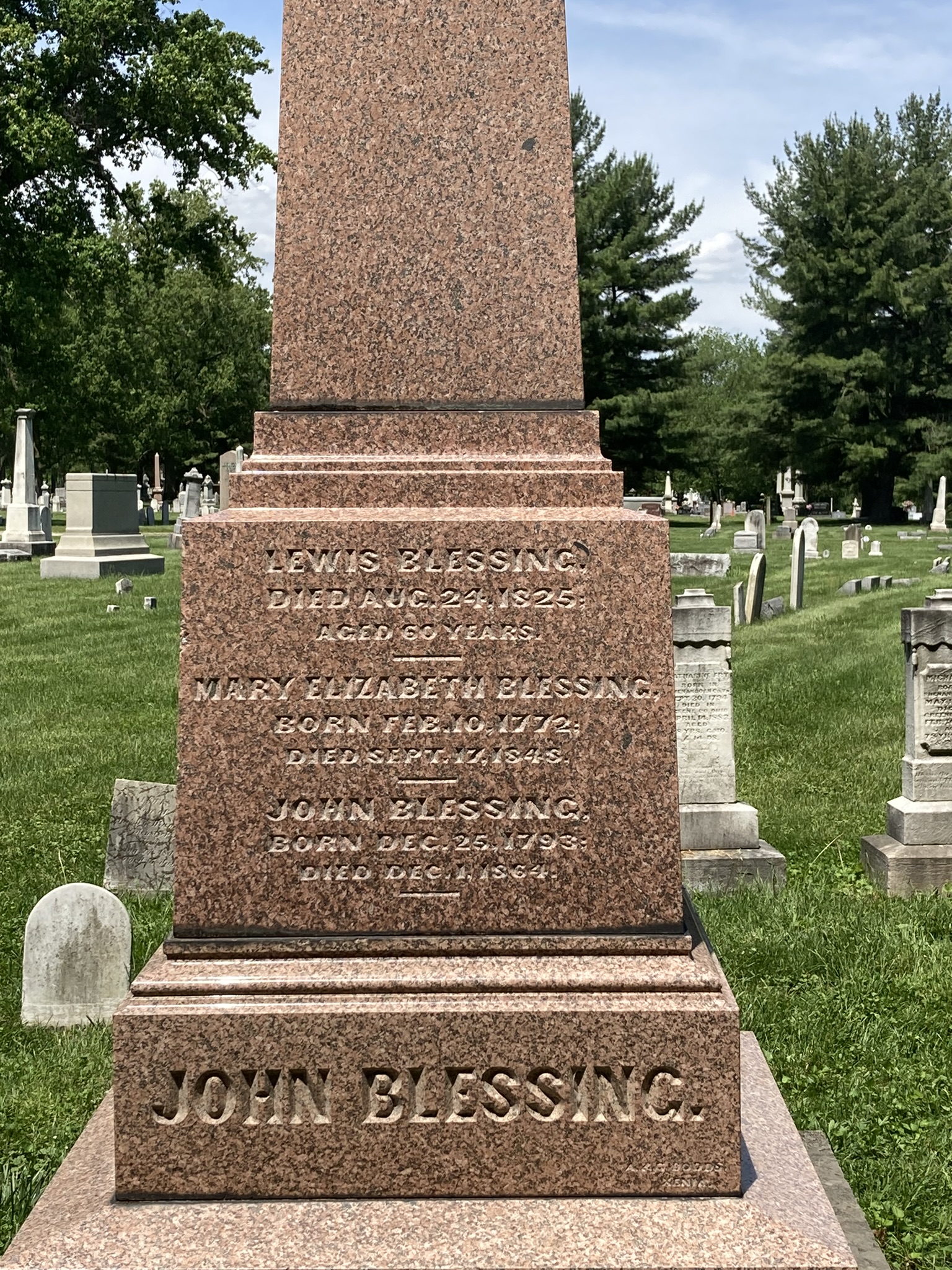
The second-oldest brother, Jacob passed away—along with his father, Lewis—within a year of arriving in Beaver Creek Township, Ohio from Shenandoah County, Virginia. He didn’t marry and had no children. He was thirty-two years old when he died on July 13, 1825. He and his father were buried in Woodland Cemetery, Xenia, Ohio.
Despite losing their father, who had immediately continued the success he’d enjoyed as a landowner in Virginia, the remaining Blessing siblings in Ohio, John, Mary, and Elizabeth continued to prosper in their new home.
John Blessing
John Blessing, born on December 25, 1793, had served as a private in Company F of the 34th Ohio Infantry during the War of 1812, when the British and America fought for the last time.
When John’s father, Lewis, entrusted him to find land in Ohio for the family’s move west, “his objective point being the valley of the Little Miami in [Greene] county, excellent reports of which section had been going back to Virginia.” Lewis had sent John with such a large amount of money that he traveled in disguise in order not to attract thieves, “carrying with him a…musical clock…exhibitions of which along the way invariably secured for him welcome hospitality.”
After his father’s death in 1825, John “continued to develop the place on which the family had settled.”
In Lewis Blessing’s will, he left John 150 acres that was part of the 190 acres he purchased when he decided to settle in Ohio. Lewis outlined the area for John as “on the bank of the Little Miami, at Stokes’ lower corner on the river, and running so far down that river with my line, that running easterly, parallel with the original line out from the river.”
As a condition for the land, Lewis requested that John finish his barn and “build a dwelling house on the same lot on which the barn stands. The said dwelling house and half of the barn is to be for the use and occupation of my wife during her natural life, and for the use and benefit of my two daughters, Mary and Elizabeth, so long as they may continue single.”
In the 1850 Census, John, his sister Mary, her husband and children, as well as their younger sister, Elizabeth are all listed in the same farming household, even though each owned different parcels of land.
By this time, John’s real estate value was $21,000–a tremendous sum for the time. This consisted of seventy-five acres of improved land, and eighty-eight acres of unimproved land. The cash value of his land was $10,000, and his farming equipment was worth $100. His livestock consisted of three horses, three milking cows, five cattle, thirty-eight head of sheep, and ten pigs, worth a combined $357. John also grew wheat, Indian corn, and oats; 150, 1200 and 33 bushels of each, respectively.
By 1860 John’s real estate value had increased to $28,940, and his personal estate value was worth $10,000. John continued to prosper.
John never married, so when he passed away on December 1, 1864—with no will—his fortune and land, worth $85,000, was left to his two sisters, Mary and Elizabeth.
His obituary in The Summit County Beacon in Akron, OH on December 22, 1864 noted that, “Mr. John Blessing, residing a few miles north-west of Xenia, while chopping wood was taken with disease of the heart which resulted in death.” It seemed to me an unremarkable obituary for a prominent settler and land owner in the area. Perhaps there was a longer one written in a different newspaper, but I have yet to find it.
He had retained his uniform as a soldier of the War of 1812 and his sister, Mary Blessing Lucas still possessed his old “Lafayette chapeau which was the distinguishing feature of that uniform.”
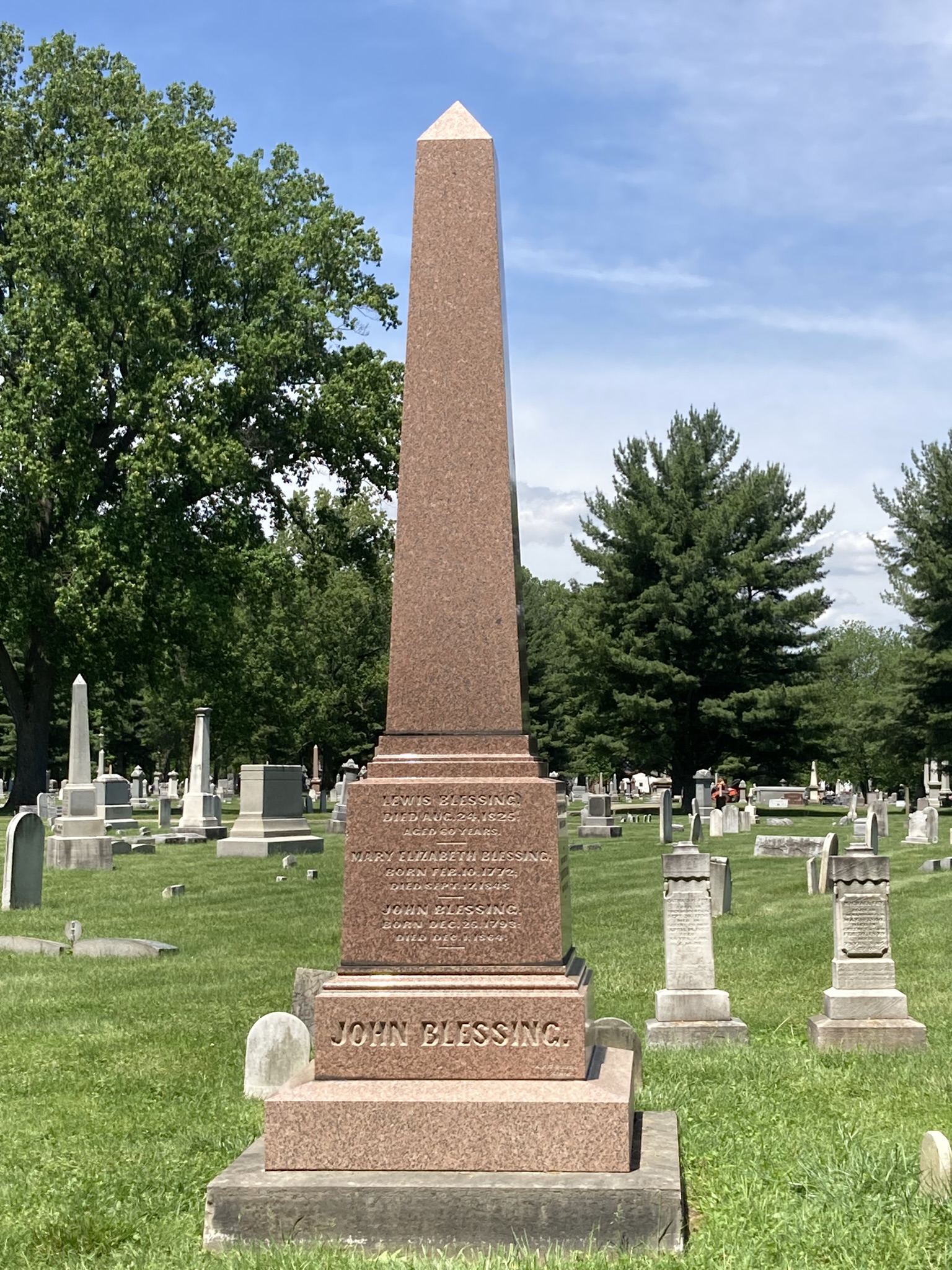
He’s buried in Woodland Cemetery, Xenia, Ohio with an obelisk that honors his parents and brother, Jacob, who passed away before him.
Click to read Part 2 of this story
Sources and Additional Info
John Blessing’s military details from Page 2 of the Ohio, Soldiers Grave Registration Cards, 1804-1958
Details about the Blessing’s move to Ohio and John’s military hat from History of Greene County, Ohio: its people, industries and institutions by Michael Broadstone Volume 2, Part 2, pp 149 – 150
Information on what John owned and the value in 1850 and 1860 from the US Census from those years.
 The Women Who Gave Us a Legacy of Strength